
 Drum Atlas
Korg MS-20
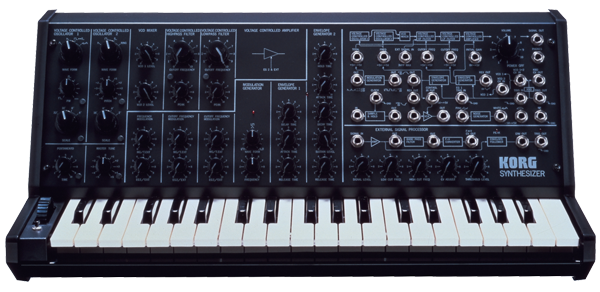
Two oscillators, high- and low-pass filters and a patch panel for new connections.
The original model appeared in 1978.
- Voices
- 1
- Keys
- 37
- Sound design
- 2 VCO’s
- Introduced
- 1978
Sound & character
The MS-20 is a monophonic synthesizer with 37 keys. Its basic route is internally connected, so you can play without patch cables. The patch panel changes control and modulation. The external signal processor also lets you explore other audio sources.
Model & versions
The original model appeared in 1978. The later MS-20 mini is smaller and has MIDI/USB; those features cannot automatically be attributed to a vintage MS-20. Identify the version in every listing and use its own documentation.
How the sound works
Choose a section and discover what it does.
Oscillators
Two VCOs provide the starting material. Their tuning and waveforms change the combination.
What to checkListen to each oscillator separately, then together.
Open the manual ↗Explore in depth
Semi-modular: start without cables
The basic signal route is internally connected. Learn the oscillators, mixer and filters before using the patch panel. A cable changes a particular connection; it does not automatically replace the entire internal route. Follow the panel markings and manual.
Two filters provide many colours

High-pass and low-pass filters together delimit part of the spectrum. Their peak controls can produce strong resonance. Korg documents a filter change during original production; do not judge a unit solely by its name or supposed tonal reputation.
The external signal processor

The ESP enables experiments with external audio. Pitch and level can be used as control signals. This does not mean flawless conversion of every chord into synthesizer notes. Start with a simple signal and check input level and settings against the manual.
Korg · MS-20 Original Owner’s Manual ↗ · Korg · MS-20 mini · Features ↗
Identify original and mini
Korg specifies the mini as 86% of original size, with smaller patch plugs. MIDI and USB belong to that reissue, not automatically to the original MS-20. Check dimensions, model plate and connections. Ask a specialist to substantiate any filter-revision claim.
Try listening yourself
A short listening exercise on the instrument. Use a copy of your sound and change one setting at a time.
- Remove patch cables and use one oscillator. Change one filter at a time at modest volume.
- Add the second oscillator slightly detuned, then compare with both oscillators tuned alike.
- Try one modulation patch from the original manual. Note the connection and remove it to hear the difference.
An editorial exercise, not our own listening test or a built-in audio demo.
Specifications & sources
- Keys
- 37
- Voices
- 1
- Sound source
- 2 VCO’s
- Filters
- HPF + LPF
- Program memory
- Geen
- Control
- CV / trigger / patchpaneel
Sources checked: 7 October 2026.
This dossier covers the original hardware. Controls and technical data are based on manufacturer documentation; buying checklists are our editorial suggestions. No in-house listening test or valuation.
Experiences & questions
Loading experiences…
Explore more
Vintage Corner →
JUNO-106
One oscillator per voice, six voices and a chorus that widens the sound.
Open dossier →